
2026 VNP Stargazing and Aurora Guide
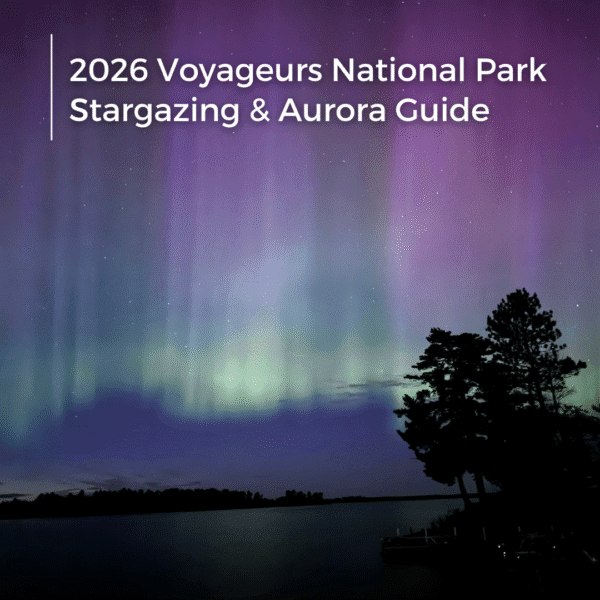
There is something magical about standing under a dark sky full of stars. In 2026, Voyageurs National Park will once again be one of the best places in the Lower 48 to watch the heavens come alive. From the flicker of the Milky Way to the dance of northern lights, this guide will help you plan your nights under the stars with confidence and wonder.
We’ve blended information from our favorite night sky resources into one practical guide for explorers, photographers, families, and dreamers heading to Northern Minnesota this year.
Why Voyageurs Is a Star Lover’s Paradise
Voyageurs sits far from city lights in the heart of the boreal forest. Its lakes and wild spaces give you clear views to the horizon. That means darker skies, stunning constellations, and a real chance to see the Milky Way with the naked eye.
Plus in 2026 we are expecting strong seasonal aurora activity as the sun nears the peak of its cycle. That brings more chances to see green, purple, and pink light shimmering overhead.
2026 Moon Phases for Stargazing
The moon plays a big role in how bright the night sky appears. For the darkest skies that let you see the Milky Way and faint nebulae, plan your nights around new moons.
Here’s how the 2026 moon schedule shapes up for Voyageurs National Park:
- January 11 New Moon Best for deep dark skies
- February 9 New Moon
- March 10 New Moon
- April 8 New Moon
- May 8 New Moon
- June 6 New Moon
- July 5 New Moon
- August 4 New Moon
- September 2 New Moon
- October 1 New Moon
- October 31 New Moon
- November 30 New Moon
- December 30 New Moon
On New Moon nights, the moon rises late and sets early. That gives you the darkest skies possible for seeing the Milky Way arc overhead. On nights near Full Moon the sky will be brighter. That can wash out the dimmest stars, but it still makes for beautiful moonlit landscapes.
Tip for planning: Check the exact moonrise and moonset times on the dates you will be in the park. The moon’s schedule changes about 50 minutes each day.
Viewing the Milky Way in 2026
For photography and Voyageurs, understanding where the Milky Way appears in the sky is key.
From late spring through fall, the Milky Way is visible as a faint glowing band stretching across the night.
Here’s how to find it:
- In May and June look to the south and southeast just after astronomical twilight. The bright galactic core becomes visible later at night.
- In July and August the Milky Way arches high overhead. That gives great opportunities to photograph the core near midnight.
- In September and October it still rises in the southeast and sweeps toward the southwest as the night goes on.
When the core is visible the sky seems to have a soft milky glow. With a wide angle lens you can capture it arching over pine forests and glassy lakes around Lake Kabetogama.
Best Spots in Voyageurs National Park for Night Sky Views
There are a few magical places in and around Voyageurs where the sky truly opens up after sunset. The Kabetogama Peninsula offers wide open views over the lakes, giving you a big stretch of horizon and very little artificial light. It feels expansive and peaceful, especially when the water is calm and the stars begin to reflect on the surface.
During summer months the Woodenfrog State Forest Campground day use beach area is prime viewing with public access. With few lights around and a great panoramic view over Kab, this is a favorite spot for local photographers looking to capture peak aurora activity.
These areas are naturally shielded from heavy light pollution. On the darkest nights visitors often describe seeing more stars than they knew existed, with the Milky Way softly arching overhead from horizon to horizon.
Lastly and most importantly, Northern Lights Resort is named after the aurora because we believe one of the best places to view the aurora is right here, at our resort!
Chasing the Northern Lights in Northern Minnesota
The aurora is one of the most unforgettable sights in Northern Minnesota skies. While it is never guaranteed, Voyageurs’ northern latitude gives you a real chance to witness the show.
The best way to improve your odds is to check geomagnetic activity forecasts before your trip so you know when solar activity is elevated. When strong aurora conditions are predicted, head north and away from town lights as soon as darkness settles in. Choosing nights close to the new moon will give you darker skies and better contrast, allowing the colors to stand out more clearly. When the aurora begins, look low to the northern horizon first. As activity increases, the lights often rise higher and can eventually dance directly overhead.
Auroras often begin as a faint green glow near the horizon. With stronger activity they ripple, twist, and shimmer across the sky in waves of green, pink, and purple. Photographers love capturing long exposures of the aurora shimmering above lakes and pine forests. Just plan for late nights, dress in warm layers, and bring plenty of patience. The sky rewards those who wait.
Photography Tips for 2026 Skies
For those focused on night sky photography around Voyageurs, a little preparation goes a long way. A wide angle lens allows you to capture sweeping Milky Way arcs and full curtains of aurora in a single frame. Setting your ISO high enough to gather light while keeping noise manageable will help preserve detail in the stars. Many photographers find exposures between 10 and 30 seconds strike a good balance between sharp stars and rich sky color.
Take time to think about your foreground as well. Trees, rocky shorelines, docks, and calm water can add depth and a true sense of place to your images. The best shots often combine sky and landscape into one peaceful story.
Before you head out, always check the weather and moon schedule. A bright moon or a layer of clouds can completely change your plans. When conditions line up, though, the night skies over Northern Minnesota offer unforgettable moments for both the eye and the camera.
2026 is shaping up to be a beautiful year to experience the night sky in Voyageurs National Park. Pack warm layers, a good star chart, and your sense of wonder. We’ll see you under the Milky Way.
Explore More about viewing our Voyageurs Night Skies
Tips for Aurora Chasing at Northern Lights Resort
Resources for Night Sky Photography and Aurora Hunting
FAQ for viewing the Aurora and Milky Way
- Is there a best time of year for seeing the aurora in northern Minnesota or lower 48 ?
Anytime is a great time to aurora hunt in the Voyageurs National Park area. The National Park reports over 200 times a year the aurora can be viewed.
We recommend a fall trip to increase your chances of seeing the aurora: With the longer nights and crisp cool air improves the aurora viewing. Also, dark skies and avoiding a full moon also helps aurora hunters.
- When is the best time to see the Milky Way core in northern Minnesota? During the new moon the core is more visible and the summer – refer to our guide above for ideal times for each month. The core viewing season for the Milky Way is May – Oct. See our Milky way viewing guide for more tips on viewing.
In Minnesota in 2026, the Milky Way core is visible from late March through October. The best viewing, offering the highest, clearest, and longest-lasting views of the core in the night sky, occurs during the summer months, specifically from late May through August.
- Late Feb – March: The core becomes visible in the early morning (predawn) hours.
- April – May: Visible in the early morning, with visibility starting earlier in the night by May.
- June – July: Prime time; the core is visible for most of the night, reaching high in the sky.
- August: Excellent viewing, especially earlier in the month, with good visibility before dawn.
- September – October: The core is visible in the evening, with the viewing window closing earlier each night.
For the best viewing in 2026, plan your trip during a new moon phase to avoid light pollution. Locations like Voyageurs National Park, the Boundary Waters (BWCA), and the North Shore are top spots in Minnesota.